

Connoisseur Plants
Connoisseur Plants are rare, new plants, or hard-to-find old favorites. These wonderful plants are being offered to our upper level members, Collector (formerly Sponsor) level and higher.
Please note that several plants are available in very limited quantities. For some plants, we don't know the full range of hardiness, only how it has behaved at the JC Raulston Arboretum. Sometimes, we cannot find any information in our references on a particular taxon. This does not mean that the plant doesn't exist, perhaps just that we are staying one step ahead of published information. One of the purposes of the Arboretum is to test new plants for suitability to the southeastern United States. By growing some of these "new-to-us" plants in your own garden, you can be a part of this evaluation process. Feedback from you is invaluable!
Happy choosing, and thank you for your continued and invaluable support of the JC Raulston Arboretum.
To submit your selections, please use the form link in the e-mail you received on February 21, 2024 from Kathryn Wall. If you need assistance, please e-mail Kathryn at kbwall@ncsu.edu or call (919) 513-7004 Selections should be placed no later than end of day March 3, 2024.
Note: The distribution year listed below is the year the plants were awarded. Members request them early the following year. And they're picked up or delivered shortly thereafter.
2000 Plant Selection
Abelia ×grandiflora 'Gold Spot'
golden glossy abelia
A new gold-leaved cultivar of the commonly grown "glossy abelia," arriving from the United Kingdom. Also sometimes known as 'Goldstrike' or 'Goldsport'. This cultivar arose as a sport of 'Francis Mason'. True plants of 'Francis Mason' possess yellow to chartreuse leaves, bordered by a rich gold margin. 'Gold Spot', in contrast, has entirely gold-tinted leaves. In all other respects, this plant will resemble typical Abelia ×grandiflora plants, albeit with perhaps more vigor and larger ultimate size. Zone 6. Sun to part-shade.
- hardy
Ageratina viburnoides
Joe-Pye shrub
For those of you who feel that you know all there is to know about the "Joe Pye weeds" (Eupatorium species), brace yourself! This Eupatorium, a native of Mexico, is a woody shrub. Yes, it is NOT a herbaceous perennial! The lustrous, dark green foliage contrasts sharply with the light-pink airy clusters of flowers that appear in November. Our specimen, only recently planted, is still being tested for hardiness. Clearly, this is a plant with a future in eastern North Carolina. Zone 8, possibly 7b.
A highly attractive cultivar of the common European alder with rich, glossy, dark green, dissected foliage. Deciduous tree up to 40' tall; although this cultivar grows more slowly in the southeastern heat, perhaps maturing as a smaller tree here. Tolerant of poor, wet soils, and our specimen has prospered under these conditions. Zone 4. Sun.
- to to 30’ with age
- plant in sun
The Amsonia's comprise one of the best groups of native American herbaceous perennials, renowned not only for their clear sky-blue flowers in spring, but also their striking golden-yellow fall color. Louisiana blue-star, native to South Carolina, Georgia, Mississippi and Louisiana, is readily identified by the distinctive dense, white, woolly hairs present on the undersides of the leaves. A striking, yet rarely cultivated, native herbaceous perennial. Zone 6. Sun.
- hardy
One of the herbaceous aralias, a group of hardy herbaceous perennials that is rarely seen and grown in American gardens, and not well known by many nurserymen. This species produces big and bold foliage, with compound leaves divided into many small leaflets, all displayed on stems rising to 6'–7' tall. In summer, stand back and watch for an explosion of billowing white flowers, all in tiny umbels (or "balls"), held on a common stalk that reaches 3' in height. A magnificent group of plants. Zone 5. Part-sun to part-shade.
Yes, you read right—a hardy begonia!! (Hardy for us, at least!) This herbaceous perennial, only "discovered" to be hardy in the 1990s, has barely begun to grace southern gardens. The foliage, resembling some of the angel-wing begonias in shape (but without the speckles), would be ornamental enough, but the display of stunning pumpkin-orange flowers that appear in summer through early autumn only adds to this plant's garden intrigue. Best in damp, shady gardens. Zone 7b, possibly colder. Shade.
Why this plant is not better known escapes me! This hybrid between the Japanese and European barberries (Berberis thunbergii and Berberis vulgaris, respectively) displays attractive purple leaves (to about 3/4" long), mottled throughout with streaked variegation. From a distance, the plant appears to have a smoky purple cast—most attractive. A very nice deciduous shrub maturing at 4'–5' tall. Zone 5.
- hardy
This selection of our native crossvine comes to us via Michael Dirr, Ph.D., at the University of Georgia. Collected as an orange-flowered variant on Jekyll Island (off the coast of Georgia), this twining vine has grown and flowered prodigiously for us on the outside of the Lath House. The long tubular orange flowers with yellow throats (versus the normal yellow and red seen most often in the wild) are a welcome new addition for gardeners interested in growing colorful vines. Semi-evergreen to evergreen foliage. Zone 6. Best flowering in full sun.
- Semi-evergreen vine to 18'–30'
- plant in sun
- hardy
- orange and yellow flowers
- attracts birds
The easiest of all hardy orchids to grow, this plant is practically bullet-proof, only suffering from our occasional late spring frosts when warm spells in late winter encourage delicate new growth to emerge too early. Still, plants always rebound. This Chinese native displays wonderful palm-like linear leaves, arranged on a stem that rises to 12"–15", topped by clusters of purple, 1"–2" orchid flowers. Very attractive, with demand always exceeding supply. Grows best in moist to damp soils in shady sites. Zone 5.
- herbaceous perennial to 12"–15"
- plant in part sun to light shade
- hardy zone 6
- pink flowers in spring
- deer resistant
Boenninghausenia albiflora var. japonica
Japanese rue
A virtually-unknown woodland perennial with attractive compound greenish-blue foliage and small white flowers, but produced in abundance so as to show up collectively. This species is close kin to the culinary herb "rue" (Ruta graveolens), but has more greenish foliage, and is tolerant to shade. Plants are clump-forming, up to 15"–24" tall. Grown from seed. Zone 5 or 6.
This is a rare and truly distinctive beautyberry, hailing from Guangdong Province in southern China. Our specimen of this deciduous shrub exhibits beautiful narrow, elliptic-shaped leaves, with rich dark purplish-green foliage. It is completely different from all other beautyberries in our collection. Fruit are indicated to be pinkish-purple in color.
- deciduous flowering shrub to 3'–5'
- plant in sun to part shade
- hardy
- white flowers in late spring
One of a group of native perennials that curiously has not garnered a widespread gardening following. Native from the southern Great Plains to the Mississippi Valley states, "winecups" displays leaves that are cut into finger-like (or "digitated") segments on stems rising 1'–4' tall amid masses of 1"–2" wide white or purplish-red Hibiscus-like flowers produced on long stalks. Expect flowers from late spring through summer. A unique and hard-to-find perennial plant. Zone 6, possibly colder.
- hardy
A fantastic climbing clematis hailing from the Himalayas and China. Few plants can match its floral exuberance. Amid finely cut foliage comes an explosion of yellow (or golden-yellow) lantern-shaped flowers, 3"–4" wide. After the flowers have faded, curious mopheads consisting of multiple fruits with long silky tails, appearing like discarded wigs, adorn the plant and sparkle in the sun. Like other clematis, this one thrives in sunlight but prefers its roots to be kept cool. Zone 5.
- deciduous vine to 5'–8'
- plant in sun to part shade
- hardy
- yellow flowers in summer
- silvery mophead-like fruit in summer
Clethra alnifolia 'Fern Valley Late Sweet'
late summersweet clethra
This remains a relatively unknown cultivar of an up-and-coming native deciduous shrub. Sweet pepperbush (also called "summersweet clethra"), as you can now guess, normally flowers in the height of summer (July–August), producing sweet-scented spires (usually 4"–8" long) of white flowers. 'Fern Valley Late Sweet', however, does not flower until September–October, greatly extending the landscape usefulness of this wonderful shrub (5'–6' tall). Expect stunning yellow fall color, too. Zone 4.
- hardy
This deciduous shrub that we have been watching for the past 4 years, now only 3'–4' tall, displays bluish-green leaves arranged opposite along the branches, appearing fern-like at first glance. In summer, inconspicuous flowers are produced, but under careful inspection, one notes that the petals remain attached, swelling to form rich reddish-purple shells around the hidden fruits. These "fruits" are quite showy. Our specimen has grown fine in full sun, but with some afternoon shade. Remember not to cut back older branches since flowers are produced on the previous-year's wood. Zone 7b, possibly colder."
- hardy
This fine hybrid, originating at the famous Hillier Nurseries of southern England, combines the best of both worlds—the stunning purple foliage of a purpleleaf cultivar of European smokebush (Cotinus coggygria 'Velvet Cloak') and the stature, larger leaves, and fall color of our native smoketree (Cotinus obovatus). The result is a large deciduous shrub (15' tall) with purple foliage (until about late June–early July) that fades to bluish-green. Massive clusters of pink cotton-candy-like flowers (14" across) adorn the shrub in high summer. In fall, expect vivid shades of red, orange and yellow. 'Grace', named for the wife of the hybridizer, will hopefully grace your garden. Zone 5.
- hardy
A 1972 introduction from Duncan and Davies Nursery of New Zealand. Of all the Arizona cypress cultivars in our collection, none has brighter golden foliage than this clone. One specimen, planted in 1995, is now 12' tall and exhibits a splendid dense form. Despite being native to the arid southwestern United States, smooth Arizona cypress has proven to be a resilient evergreen tree tolerant of our (comparatively) wet climate. A sunny site is essential. Zone 7a.
- hardy
An old French clone of Arizona cypress that bears creamy-yellow suffused foliage, creating a warm-toned appearance to older plants that contrasts wonderfully with blue-leaved counterparts. Our specimen, located near several blue-leaved conifers, is now 7' tall, having been planted in 1996. This cultivar is definitely a slower-grower than 'Golden Pyramid', but the two plants are quite distinct in color. As before, full sun is necessary. Zone 7a.
- woody evergreen to 15'
- plant in sun
- hardy
This curious iris relative, native to Brazil, Uruguay, and Argentina, fools most people into thinking it is a palm seedling due to its pleated blue-green leaves, especially as they first emerge in spring. However, despite this demure beginning, stand back (!)., because in summer, each 24" tall plant is crowned with a festival of blue flowers with yellow and white spots. This herbaceous perennial plant will change the way you think about bulbs, and irises in particular. Sun. Zone 7b, possibly colder.
- herbaceous perennial to 24"
- plant in sun
- hardy
- blue flowers in summer
This cultivar, originating from Woodlanders Nursery in Aiken, South Carolina, is probably the first named selection of this undervalued native deciduous shrub (semi-evergreen on the coast). While the typical species will form large shrubs (15' tall), 'Graniteville' forms an almost prostrate-growing, low shrub (1'–3' tall). Enjoy this plant, too, for its wondrous display of fragrant, unique white flowers, and later for its orange-red fall color. Native on wet sites, but adapts fine to normal garden conditions. Zone 6.
- to 3'
- plant in sun to part shade
- hardy
A fine addition to the list of hardy ferns that are suitable for southern gardens, this fern, hailing from eastern Asia, is related to but much hardier than the "common holly fern" (Cyrtomium falcatum) of coastal North Carolina and Deep South gardens. On mature plants, expect a tight clump (24"–30" across) of matte-green fronds ("fernese" for leaves) of finer texture than the common holly fern. Zone 6.
- evergreen perennial to 30"
- plant in shade
- hardy to zone 6
- deer resistant
Dryopteris filix-mas 'Barnesii'
Barnes' male fern
A unique selection of the "male fern," a European native hardy fern, 'Barnesii' displays narrow fronds that are held in a distinct upright habit. Mature plants are usually 3' tall and only 4" wide! As with other hardy ferns, this fern is at home in a shady, moist woodland garden setting, but it also performs well on sites with part-day exposure to bright sunny conditions. Zone 4."
What kind of common name is that?!? Well, since Echinacea refers to the "purple coneflowers," most of which are purple-flowered, this species is indeed a paradox—a yellow-flowered purple-coneflower! However, flower color aside, expect the same toughness you've come to expect from Echinacea's: drought tolerance, cold hardiness, and the ability to grow in the poorest of soils. Just don't expect purple flowers! Native to Missouri and Arkansas. Zone 5.
One of the finest variegated deciduous shrubs available. This plant, formerly known under the equally difficult-to-pronounce name Acanthopanax sieboldianus 'Variegatus' (and still sometimes sold under this older name), has made slight inroads into the southern gardening consciousness, but is worthy of more widespread consideration. Grows well under sunny or shady conditions, and tolerates drought. This is a shrub that can handle the worst of all garden sites—dry shade; as well as the more congenial ones. Zone 4.
- deciduous shrub to 6'–10'
- plant in sun to shade
- hardy
Although conventional widsom holds that heaths cannot be grown in the southern states, Michael Dirr describes the Erica ×darleyensis cultivars as a "credible starting point" for finding heaths that are adapted to our climate. Among the literally hundreds of cultivars of heaths in existence, only a few can handle our heat and humidity. Well, this is one of those few. 'Silberschmelze' (which translates into "molten silver") is a pure-white-flowered winter-blooming heath. Grows only 24" tall, forming a dense mound. Zone 6.
Euonymus alatus 'Rudy Haag'
dwarf burning bush
More compact than the commonly seen "burning bush" (Euonymus alatus 'Compactus'), 'Rudy Haag' is currently difficult to procure, but is likely to become a major landscape plant of the future. Even at 15 years-old, plants are only 4'–5' tall! Fall color ranges from pinkish-red to red. Possibly one of the finest deciduous shrubs that is useful over the long term in a foundation planting. Zone 4.
- hardy
A deciduous, small-statured tree that matures at 20'–25' tall. It is valued for its medium-green foliage, furrowed bark in age, and particularly its amazing display of rich pink, four-sided fruits. Our specimen at the Arboretum has at times simultaneously displayed a heavy crop of rosy-pink fruits amid a colorful medley of pink and yellow autumn foliage. Beautiful! This is an unknown but worthy tree suitable for small urban lots. Zone 4.
- hardy
A large deciduous shrub, ultimately reaching heights greater than 10' tall, with prominent broad corky ridges along the twigs. Our three year-old specimen is now 5' tall. Plants display rosy-pink fruits and pink leaf tints in autumn. Few plants can match this plant for the winter effects provided by the corky ridges on the twigs. Mature shrubs are a study in 3-D during the winter season. Zone 5.
Witchhazels are one of the glories of winter, displaying their flowers with crinkled petals that catch the winter sun and glow as if on fire. 'Diane' is one of the best of the red-flowered cultivars, producing abundant coppery-red flowers with a faint sweet fragrance in February. Plants are shrubby in habit, maturing at 10'–15' tall, and fall color can be a rich yellow to red. Zone 5.
- hardy
This lesser-known cultivar of witchhazel, introduced from the famous Arboretum Kalmthout of Belgium, forms a wide, spreading shrub of 10' or more by slightly less tall. In late January through early February, glistening flowers open revealing clear yellow petals with wine-red cup-like bases—a two-toned flower, beautiful on close inspection. Among the most fragrant of the witchhazels, 'Primavera' will perfume the garden surrounding it. In fall, enjoy its yellow leaf color. As with 'Diane' above, these shrubs are plants for the quieter season—a time when most other plants are minor players in the garden setting. Zone 5.
- flowering tree to 10'
- plant in sun to shade
- hardy
- yellow flowers in winter
Named after the islands to which it is native, this hosta is not one you'll find in most, if any, nursery catalogs. (The Tsushima Islands occur between Japan and South Korea in the Korean Strait.) Mature plants occur as tight mounds, 12" tall by 30" wide, covered in wavy-margined green leaves. However, the true glory of this hosta lies not in its foliage, but rather in its flowers. In August, many scapes (= flower stalks) arise from the crown of the foliage, reaching 24"–30" in height, and are adorned by dozens of purple, nearly striped white, funnel-shaped flowers, 2" in length. Zone 6. Be the first person on your street to lay claim to this rarity.
- hardy
This large blue-flowered mophead hydrangea derives from a selection made by Michael Dirr at the home of Coach Vince Dooley of University of Georgia fame. But, SEC vs. ACC biases aside, this is a fantastic hydrangea. What distinguishes this plant from others is the flower-bud cold hardiness. Late freezes, which often destroy the flowers of Hydrangea macrophylla, have not bothered this plant, such that summer flowers are assured. For those of you who prefer the lace-cap hydrangeas, this plant is not for you. 'Dooley' forms plants reaching 4'–5' tall. Not the easiest hydrangea to find in commerce. Zone 6.
- hardy
An old Chinese cultivar, and also long grown in Japan, 'Otaksa' forms the typical mophead flowers that are responsive to soil pH conditions. Thus, under acid conditions, blue flowers are produced; whereas under alkaline conditions, pink flowers result. Leaves have red petioles (= leaf stalks), an added bonus for foliage interest. Expect plants to reach 3' tall. Zone 6. seed grown?
Hydrangea serrata f. acuminata
narrowleaf mountain hydrangea
Just beginning to become known in southern gardens are the fabulous cultivars of the "woodland hydrangea," a native of Japan and Korea. The plants offered here are lace-caps, and are blue-flowered under acid soil conditions. One of the distinct advantages of growing Hydrangea serrata is the improved cold hardiness (vs. Hydrangea macrophylla cultivars). These plants possess narrower leaves with a long drip tip versus the typical form (H. serrata f. serrata), which has broader leaves. Some can have reddish stem coloration. Our plants are seed-grown, from seed sent to us by friends in South Korea. Zone 5.
- hardy
This hardy herbaceous perennial, of which I first became acquainted by introduction from Doug Ruhren (now of Daniel Stowe Botanical Garden), is one that I have been watching. Whereas many purpleleaf sedums are currently available, with some performing fine for us and others not; most of these cultivars display reddish-purple leaf color. 'Purple Emperor' is entirely different, appearing as a slate-purple due to a thin white, waxy overlay to the leaves that gives them a bluish-purple tone. We have not fully tested this plant yet, although I know that it has been successfully grown in some Piedmont gardens. Try out this relatively newly imported (from the United Kingdom) sedum, and let us know what you think. Zone 4.
- to 15"
- plant in sun
Named and introduced in 1938 by the late W. Edingloh of the New Bern Nursery (now defunct), this holly derives its name from a contraction of Carolina. (CAroLINA - "ro" = 'Calina') For us at the Arboretum, 'Calina' has been a proven winner, a beautiful evergreen holly now about 20' tall, with a consistent, stunning display of large, red berries. Although the plant is not as dense in foliage as 'Nellie R. Stevens', its berry display is so heavy that this outweighs any detracting attributes. Also, the berries are among the largest of any observed in the holly collection at the Arboretum. Zone 7a, possibly colder. Sun to part–sun.
- hardy
A lesser known holly with an odd cultivar name (albeit no less so than the ubiquitous 'Nellie R. Stevens'), but don't let this deter you from trying it. Mature plants form beautiful evergreen pyramids, up to 20'–25' tall, with wonderfully attractive, glossy dark green leaves with short-spined margins. Fruit loads on this cultivar are reported to be tremendous, although I don't recall seeing much on our specimen (now removed, making way for newer items) at the Arboretum. However, in Wirt's defense, our plant grew in moderate shade, which may have contributed to its lesser fruit set. Among the hybrid hollies, 'Wirt L. Winn' will always rank as one of the best for foliage quality, as well as its fast growth rate. In my opinion, there is no good reason why 'Wirt L. Winn' shouldn't be as popular as 'Nellie R. Stevens'. Zone 6b.
- to 20’–25’
- hardy
Juniperus virginiana var. silicicola 'Brodie'
Southern redcedar
Much lesser known than the commonly seen "eastern redcedar," Juniperus virginiana (var. virginiana), but undervalued and underutilized in modern landscapes. This tall, columnar, evergreen conifer displays bright green foliage (vs. the dark, somber black-green foliage of eastern redcedar). Expect mature plants of 'Brodie' to reach 20'–25' tall by 4'–6' wide. Also displays much better salt tolerance than eastern redcedar, as southern redcedar is native to coastal areas of North Carolina, south to Florida and Texas. Zone 7a, possibly much colder.
- hardy
A remarkable Asian relative to the firs (Abies), this plant has prospered at the Arboretum, and now towers at 25' tall (probably as one of the largest specimens of this species in the eastern United States). This evergreen tree possesses short, flattened, nearly plastic-like, bright green leaves, which emerge in spring as a coppery-pink color. Although fully hardy for us, the new spring growth is sensitive to damage by late spring freezes. Plants being distributed are derived from seeds collected off of our tree, which coned for the first time last year. An exciting and exceedingly rare conifer that has prospered in our hot and humid climate. Zone 7a, possibly colder.
- hardy
Lagerstroemia 'Basham's Party Pink'
crepe myrtle
One of the most widely cultivated crepe myrtle cultivars in the Deep South, 'Basham's Party Pink' arose as a chance seedling discovered by a Bill. Basham of Conroe, Texas. It was first introduced into cultivation and then promoted by one of the great plantsmen of Texas, the late Lynn Lowrey. 'Basham's Party Pink', a hybrid between the "common crepe myrtle" (Lagerstroemia indica) and the "Japanese crepe myrtle" (Lagerstroemia fauriei), displays the best of both species—the lavender-pink flowers of the former, and the vigor and stature of the latter (20'–25' tall). Unfortunately, it is not the hardiest of crepe myrtles, and thus is best reserved for the milder areas of North Carolina. Zone 7b.
Lagerstroemia indica 'Baton Rouge'
miniature crepe myrtle
This plant is one of a series of dwarf crepe myrtles, first sold during the 1970s in Louisiana, that matures as a small-statured shrub. 'Baton Rouge' displays heavy crops of bright rosy-red flowers held in large panicles from June through October. Our plant, now over 12 years-old, is only 4'–5' tall. If you think that all crepe myrtles are trees, then this plant may come as a surprise. Crepe myrtle cultivars such as 'Baton Rouge' represent some of the exciting "new" avenues in crepe myrtle breeding that we are just beginning to exploit for use in our southern gardens. Zone 7a."
Lagerstroemia indica 'Bourbon Street'
miniature crepe myrtle
This cultivar represents one of the dwarf selections named by David Chopin, now of Pennsylvania, back in the 1970s. 'Bourbon Street' forms an even smaller-statured plant than 'Baton Rouge' and produces the classic "watermelon red" flowers in abundance from June through October. [Incidentally, none of the hybrids between Lagerstroemia indica and Lagerstroemia fauriei (see 'Basham's Party Pink' above) display this rich dark color, the closest to true red that is available in any crepe myrtle. This is probably due to the fact that the white-flowered L. fauriei, when hybridized with even a dark-colored L. indica, dilutes the intensity of the pigments in the offspring.] Books list 'Bourbon Street' as growing 2' tall, but our specimen is slightly large, although considerably smaller than a "typical" crepe myrtle of similar age. Zone 7a.
Lagerstroemia indica 'Peppermint Lace'
crepe myrtle
This introduction of Monrovia Nursery of California is one of several bi-colored crepe myrtle cultivars. 'Peppermint Lace', which ultimately forms a tree 15'–20' tall and wide, produces interesting flowers that are dark pink with a pure white picotee edge. Since each petal is creped (the origin of the common name crepe myrtle), the effect of these two colors is even more interesting when observed up close—akin to candy stripes. However, from a distance, the effect is lost, the plants appearing to be pink-flowered only. The foliage quality of this plant is great, with leaves appearing dark black-green. Always a handsome plant. Zone 7a.
Derived from breeding program in Louisiana and Florida, selecting crepe myrtles for dwarf stature; This cultivar, the final one in our trio of offerings of the Chopin 1970s miniatures, was released in 1984 as the "official plant of the 1984 World's Fair," held in New Orleans. As with 'Baton Rouge' and 'Bourbon Street', 'World's Fair' has remained a dwarf-statured plant in our collection at the Arboretum, now only reaching about 4', 12 years after planting. Flowers, produced over the summer months, are dark rosy-red in color. Zone 7a.
- to 4'–6'
- plant in sun
- hardy
Received as seed in 1994 from Chollipo Arboretum in South Korea, this new species crepe myrtle has rocketed up to 12' tall with beautiful form and branch structure. Although ultimate size is unknown, our plant appears destined to be a large tree (by crepe myrtle standards = 25'+). I continue to be impressed by various attributes of this species: 1) the rapid growth rate; 2) exfoliating bark that just appeared this year, revealing a cinnamon-brown layer beneath, not unlike that of Japanese crepe myrtle (Lagerstroemia fauriei); 3) an amazing fruit display; YES, fruits—you have to see it to believe it; and 4) pale-pink flowers on a plant that has leaves twice the size of any other crepe myrtle commonly grown. This botanical rarity is a native of eastern China (Zhejiang, formerly Chekiang, Province). Zone 7a, possibly colder.
- deciduous tree to 25'
- plant in sun
- hardy to zone 7 hardy
- blackberry ice cream colored flowers in early summer
- exfoliating bark
Lagerstroemia 'Sarah's Favorite'
crepe myrtle
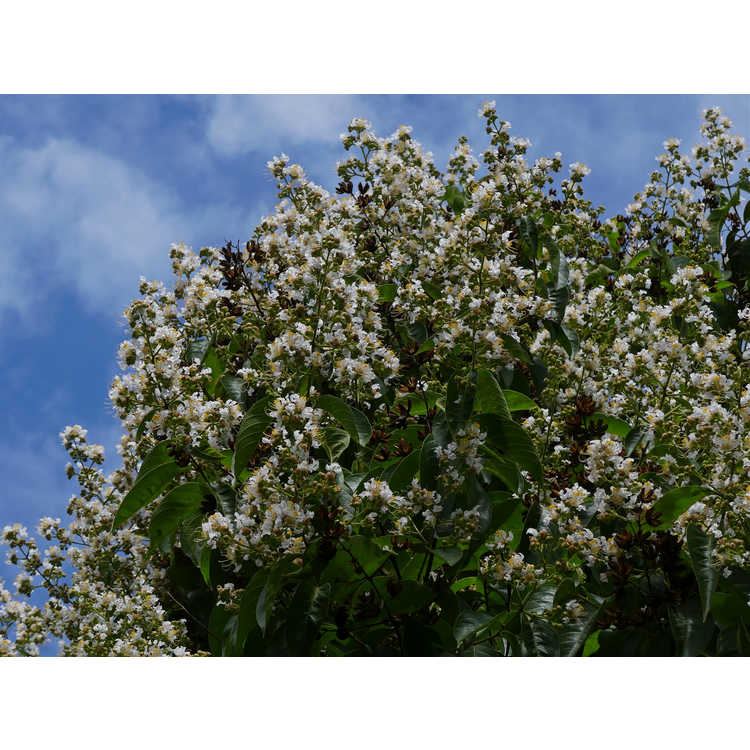
One of the Lagerstroemia indica × Lagerstroemia fauriei selections, 'Sarah's Favorite' represents a U.S. National Arboretum seedling that originally did not "make the cut" and was slated for the compost heap. Named instead by Tom Dodd Nurseries (in Alabama), this plant has turned out to be quite similar, albeit more cold hardy, than the ubiquitous 'Natchez' (which is currently the standard bearer for white crepe myrtles with cinnamon bark). 'Sarah's Favorite' also displays cinnamon-colored bark common to many of these hybrid crepe myrtles. Of course, only time will tell if this plant should have been discarded or not. Help us to decide by sending us your observations on this plant, one that is relatively new to our collection. Zone 7a, possibly colder. Sun.
An uncommonly grown species crepe myrtle that should be considered much more strongly in the milder parts of the southern United States. This is the Chinese counterpart to the Japanese crepe myrtle (Lagerstroemia fauriei), both of which possess large panicles of white flowers that appear in early summer. However, Lagerstroemia subcostata is aptly named, since its bark exfoliates (= peels off) to reveal a rich, nearly ivory-white skin underneath—absolutely stunning in effect. (The Japanese crepe myrtle instead exfoliates to revel the rich reddish-brown bark.) Too undeservedly unknown, this crepe myrtle should be considered for widespread use in suitable areas. Anyone who sees a properly grown mature specimen could only agree. Zone 8, possibly 7b.
- flowering tree to 20'
- plant in sun
- hardy to zone 7b hardy
- white flowers in summer
An unusual deciduous shrub that produces a cane-like growth habit—wherein new shoots arise from the base, reaching 3'–4' in a season. Attractive on several fronts, for its rich green stems and the dangling pagoda-like clusters of small white flowers with wine-red leaf-like bracts attached, appearing in spring. Hard to describe, but quite ornamental. Later in the season, the flowers give way to rich dark purple berries. Altogether, flowers and fruit are showy from late spring through summer. Best in shade to part-shade, on moist sites. Annual rejuvenation by cutting canes to the ground just prior to budbreak in spring probably results in nicer plants. Zone 7a.
Not an entirely rare plant, but one that we like due to its restrained growth and attractive, variegated foliage. Whereas typical Ligustrum japonicum has become a pedestrian, overused, landscape plant, several atypical cultivars exist that deserve wider mention. 'Silver Star' possesses evergreen foliage in which the central part of the leaf blade is green (in parts overlain with variegated layer, thus appearing as a mottled gray-green) while the margins of the leaves are creamy yellow. Our plant matured at 6' tall after many years (>8). Sun to part–sun. Zone 7a.
- hardy
A magnificent, large, deciduous or semi-evergreen shrub (to 10' tall), with attractive lustrous dark green and glossy foliage. However, the main virtue of this unknown plant is the flora display, an amazing symphony in flowers, with blooming panicles reaching 20" long, each panicle covered with dozens of tiny white flowers. Also, these flowers come later than any other privet, arriving in July through August. On my travels in North Carolina, I have seen magnificent specimens in full flower at Montrose Garden in Hillsborough. This is a dynamic and wonderful shrub. All you need to do is give it enough sun and room to grow! Zone 7a, possibly colder.
- hardy
While looking through the Arboretum database one day, I came across the name of this plant and wondered if it was still alive in our collection. Lo and behold, it was! "What is it?," was my first question. Off to the reference books, eh?!! Well, Liriope kansuensis is an unassuming lily-turf (or "mondo grass" to some) that appears similar to the commonly grown Liriope muscari. However, based on nativity (west-central China), Liriope kansuensis could be much more cold-hardy than other lily-turfs. Plants have narrower leaves and light purple flowers on short stalks, with fewer flowers per stalk, than other commonly cultivated lily-turfs. Identity of these plants is somewhat tentative and may change based on further investigations. Zone 6, possibly colder.
- hardy
This evergreen shrub to small tree, native to north-central to central Florida, is completely new to us, having arrived via procurement from Woodlanders Nursery in South Carolina. Related to the common myrtle (Myrtus communis) of the Mediterranean region, twinberry displays numerous fragrant, white flowers (1" wide) with puffballs of stamens from April through June. The dark black-green, glossy foliage, emerging a coppery-orange color in spring, contrasts beautifully with the smooth, reddish-brown exfoliating bark. Now, some of you will balk at the notion of us growing (and recommending) plants native to central Florida in North Carolina, but the commonly grown evergreen shrub Illicium parviflorum (yellow anise-shrub) is also native only to this region, and has proven hardy up to the mountains of North Carolina. Present-day nativity isn't always a good predictor of cold hardiness. Twinberry can be, I feel confident, a phenomenal landscape plant for eastern North Carolina. It might be one for an even larger region. Zone 7b, possibly colder. Sun.
- hardy
Nolina arenicola
sand bear-grass
One of the woody-lilies, a group that includes Yuccas, Agaves and their ilk, the bear-grasses are clump-forming long-lived perennials with narrow, long leaves not unlike those of the "pony-tail palm" (Nolina recurvata), a common, albeit tender, houseplant. "Sand bear-grass," a rarely cultivated plant native only to sandy soils and sand dunes in western Texas, develops into a 6' tall clump of evergreen leaves, topped by a branched flower stalk that rises to 3' and supports masses of tiny white flowers. Think of this plant as an evergreen ornamental grass that's about as drought tolerant and tough as they get. Zone 7a.
A classic plant of the southern U.S., commonly occurring as large evergreen shrubs (almost small trees) in old landscapes and parks. 'Conger Yellow' represents one of a set of cultivars derived either wholly, or in part (as hybrids), from Osmanthus fragrans f. aurantiacus (the "orange-flowered sweet-olive"). In 'Conger Yellow', exceedingly fragrant yellow flowers (versus the normal white flowers) are produced in the autumn months, from September and October, sporadically through winter in some years. Our plant was originally received from Louisiana Nursery (Opelousas, Louisiana), which holds a more complete assemblage of cultivars of this classic southern plant than anywhere else in the United States. Zone 7a.
- hardy
This evergreen ground cover continues to amaze me with its rapid growth rate, dense form, and striking foliage. Whereas the now-pedestrian "Japanese pachysandra" (Pachysandra terminalis) has reached "dramatically overused" status in American landscapes, its Chinese cousin remains practically unknown. "Chinese pachysandra" possesses grass-green, broad, pointed leaves, set on stems that rise to 8"–10" high. Since this species has been so little tested in cultivation, we are unsure of its cold hardiness and environmental tolerances. Zone 7(a? or b?), probably colder.
- evergreen ground cover to 8"–10"
- plant in part shade to shade
- hardy
Despite the common name of this plant familiar to coastal North Carolina and Deep South gardens, plants distributed herein derive from germplasm collected in Korea in 1985. Although this germplasm has not seen much evaluative work done yet, we feel that it will prove to be more cold hardy than the Japanese germplasm that has been in cultivation for over 100 years. In the garden, Pittosporum tobira is valued in the garden as a durable evergreen shrub with pleasing foliage—dark green older leaves that contrast with chartreuse newly emerging foliage. Flowers (only produced on older plants) are delightfully, sweetly scented, perfuming the air well away from the plant itself. USDA Zone 7(a? or b?), possibly colder. Sun to part–shade.
Although most plants of Japanese flowering cherries sold are 'Kwanzan' (with double-pink flowers), many other interesting cultivars exist. Of these, 'Ukon' has to be one of the most unique, owing to its spring display of greenish-yellow flowers that tinge pink with age. Our lone specimen at the Arboretum, residing near the conifer collection, is now 20' tall at over 10 years, and is showing none of the typical signs of "old age" that so many of the Japanese cherries express only a few years after planting. This is a plant that always attracts attention in the spring, and is sure to enliven your spring garden. Zone 5.
- flowering tree to 25'–35'
- plant in sun
- zone 5
- predominantly green, lightly pink tinged flowers in spring
Native to southwestern China, Laos, and Vietnam, seeds of this fast-growing, large, deciduous shade tree were received at the Arboretum from Kunming Botanic Garden, one of the most famous of the Chinese botanical gardens. Despite the fact that the area where this species is native has a subtropical to tropical climate, "Tonkin wingnut" has prospered for us with no cold injury over the past nine years. Like hickories (Carya species), to which this plant is related, the foliage is compound, consisting of nearly 20 leaflets. However, it is in fruit that "Tonkin wingnut" shines, as the tree becomes covered in 12"–18" long hanging chains. Zone 6.
- hardy
Wow! What an attractive herbaceous perennial ground cover, this sedum makes. Its round, flattened leaves are medium green throughout the growing season, then turn a bronzy-red in the fall. In summer, plants are speckled with clusters of bright yellow flowers held on tiny stalks above the foliage like small helicopter blades. Although our plants are growing in the Perennial Border under full sun conditions, this plant has shown it can also prosper in part-shade sites. Expect plants 3" tall with a creeping habit. Although native to southern China, plants are amazingly hardy. Zone 4.
- evergreen ground cover to 3"
- plant in sun to part shade
- hardy
- yellow flowers in summer
An uncommonly encountered spirea, this white-blooming species flowers in May through June amid small, 3-lobed bluish-green leaves. "Three-lobed spirea" is as well-adapted to the southern climate as is one of its commonly seen hybrid offspring, "Vanhoutte spirea" (Spiraea × vanhouttei). 'Fairy Queen' forms a dense deciduous shrub of 3' tall, covered in spring blossoms. It should be given due consideration as a dwarf substitute for larger growing white-flowered spireas, such as 'Vanhoutte spirea" and others. Zone 3.
- hardy
Our specimen now stands at 10' tall, displaying an upright growth form, with small, fine-textured, medium-green thin leaves. As with other Styrax, spring brings forth a profusion of white flowers that hang beneath the branches and fall to carpet the ground in "snow." We expect this to be a small tree, circa 20' tall in time. Hardiness is unsure. Zone 7, possibly 6. Seeds of this deciduous tree native to eastern and southern China were originally received by us from Shanghai Botanical Garden.
Symphoricarpos orbiculatus 'Taff's Silver Edge'
variegated coralberry
This variegated cultivar of our native coralberry is too new to be in any of the books, yet. We have grown it for over 3 years now, in blazing sun in front of the Lath House; where it has performed better than expected. However, I suspect that some shade would prove beneficial in enhancing foliage quality later in the season, as our plant has looked a bit sun-bleached due to overexposure. 'Taff's Silver Edge' displays nicely variegated leaves with a yellowish-white margin, and in fall abundant crops of pinkish-red fruits, resembling unripened blueberries. Definitely an interesting plant, and one that few gardeners have probably tried. Zone 3.
- hardy
This highly architectural small deciduous tree should be considered for the garden as one might consider a "Japanese maple" (Acer palmatum). With small, fine-textured foliage, all on a small-framed tree with curving branches, this almost appears as a bonsai subject, albeit on a slightly larger scale than one is used to seeing. Our plant now stands at 6' tall, despite being squeezed in closely with other competing plants. In a more open setting, plants form beautiful specimen plants that can be as much a garden showcase plant as many a Japanese maple can. Zone 5. Sun
- deciduous small tree to 12'
- plant in sun to light shade
This herbaceous perennial, introduced by the famous British plant hunter Roy Lancaster, was collected in the nation of Georgia (formerly part of the Soviet Union) and not the United State's state by the same name. However, no matter the nativity, "creeping veronica" is probably one of the best perennials to be introduced in many years. Plants form low mats of foliage only 4"–6" tall, which in early spring are smothered by stunning cobalt blue flowers. In fall, the foliage takes on rich purple hues. Try this early flowering perennial as a foil to yellow daffodils, and get that perfect "blue and yellow" garden going early in the year. A fabulous plant! Zone 5, possibly colder. Sun to part–shade.
- to 6"
- plant in sun
- root hardy
A deciduous shrub valued for its dramatic display of tiny white flowers, produced en masse in late spring, followed by prolific crops of red fruits (<1/2" diameter) that can weigh down the branches due to their sheer mass. 'Mt. Airy' was discovered by Michael Dirr in an arboretum of the same name in Cincinnati, Ohio years back, and it is just now starting to attract its due attention as a worthy garden plant. Since plants mature at 6' tall, this is one viburnum that seems destined for a bright future. Zone 5.
- hardy
Vitex negundo var. cannabifolia
hemp-leaved vitex
Fool your neighbors with this plant that only looks illegal, but is instead a highly ornamental summer-flowering deciduous tree (to 20' tall). Yes, this Vitex has compound leaves that are dissected and finely cut, resembling certain other plants that are not distributed, nor grown, by the Arboretum. Joking aside, summer brings forth dozens of standing spires of lavender flowers that act to soothe the high-temperature blues. Related to the "chaste tree" (Vitex agnus-castus), the "hemp-leaved vitex" stands out as a larger, bolder, and much less commonly grown alternative. Zone 6. Sun.
A selection of one of our native wisteria vines, 'Longwood Purple' offers the deepest purple coloration available for this species. The JCRA has been working to assemble all of the new and old cultivars, in order to see which ones turn out to be truly distinct from the typical form, and to see which plants prove to be the more garden-worthy cultivars. "American wisteria" produces flowers in smaller racemes (= "chains") than the Asian wisterias, and the flowers emerge after the foliage but are still very showy. Zone 5.
- hardy
Zenobia pulverulenta f. nitida
honey-cups
An outstanding semi-evergreen to deciduous shrub native to boggy sites from North Carolina south to Florida. Glossy green leaves are borne throughout the year, giving way very late in the season (late November to late December) to rich red and orange tints. Spring brings on clusters of large (1/2" wide) blueberry-like, urn-shaped flowers that hang from the branches and are strongly, sweetly scented. Sun to part shade. In cultivation, two distinct forms are grown: a powdery-blue-leaved form; and, less commonly, the green-leaf form. Here, we offer the green-leaf form, simply because it is not easily procured. Both forms are highly garden-worthy. Our plant, over many years has never exceeded 3'–4' tall. Zone 5.
Zephyranthes verecunda 'Rosea'
rain lily
This bulbous plant is one of the many tough beautiful rain-lilies native to Mexico, many of which are just now beginning to receive attention from gardeners around the Middle and Upper South. Zephyranthes verecunda 'Rosea' produces pink flowers, usually 6" tall or slightly less, in summer, especially a day or so after a rain event that disrupts a dry spell. These bulbs will flower intermittently like this throughout the summer. Also, they vigorously produce offsets, such that one bulb can within a growing season yield dozens of other bulbs that will flower the next season. Since we received seeds for these plants in a recent seed exchange, we have not trialed these plants in the Arboretum over a long period, and as such we are not certain as to their hardiness. Zone 7b, possibly colder. Sun